CBD for Period Cramps: What the Research Says
An honest look at CBD and menstrual cramps: what the studies show, what else has evidence, and when to see a doctor.
Reviewed by Jessica Flowers, Certified Clinical Herbalist
Period cramps are one of the most common reasons people search for CBD. If you’re wondering whether it can help, you deserve a straight answer rather than hype. Here’s what the research actually shows, what else has good evidence behind it, how topical CBD works, and when cramps are a reason to see a doctor.
Why period cramps happen
During your period, the lining of the uterus releases hormone-like substances called prostaglandins. They make the uterus contract, which briefly reduces its blood flow, and they make nerve endings there more sensitive to pain. People with painful periods tend to have higher prostaglandin levels.
Doctors call cramps with no underlying cause primary dysmenorrhea. It usually starts in the teen years and often eases with age. Cramps caused by a condition such as endometriosis, fibroids or adenomyosis are called secondary dysmenorrhea, and they need a doctor’s care.
Does CBD help with period cramps? What the studies show
The honest answer: the research is early and promising, but far from settled. Here’s what has been studied.
Surveys of people who already use cannabis
In a 2019 national survey of 484 Australian women with endometriosis, those who used cannabis rated it as the most effective of the self-care strategies they tried. Surveys like this can’t prove cause and effect, though. People report on their own experience, and most were using cannabis containing THC rather than CBD alone.
An oral CBD trial focused on menstrual symptoms
A 2024 study in Experimental and Clinical Psychopharmacology gave participants CBD softgels for five days each cycle over three months. Their menstrual-related symptom ratings improved, especially mood symptoms like irritability, anxiety and low mood. But everyone knew they were taking CBD, and there was no placebo group to compare against, so the results need to be confirmed.
A placebo-controlled trial of a CBD tampon
One of the few placebo-controlled studies, published in 2023, tested a CBD-infused tampon for primary dysmenorrhea. Of the 63 participants who finished the three-month study, the CBD group reported significantly less pain than the placebo group in the first and third months. It’s encouraging, but it was a small trial of one specific product, delivered internally rather than on the skin.
Topical CBD on the skin
Researchers have found that skin has its own endocannabinoid system, a network of receptors that CBD can interact with. But a 2024 review in the American Journal of Clinical Dermatology notes that most evidence for topical CBD comes from lab studies, with only a few small trials in people. No studies have tested CBD balms for period cramps.
The bottom line: early studies suggest CBD may help some menstrual symptoms, but there are no large, high-quality trials yet. Anyone who promises that a CBD product will cure your cramps is getting ahead of the science.
What does have evidence: heat and massage
Two simple, drug-free comforts have stronger research behind them.
- Heat. A 2026 review of 57 randomized trials with more than 5,000 participants found that local heat, such as a heating pad or hot water bottle on the lower belly, probably reduces period pain compared with no treatment, with relief similar to common pain relievers in the studies that compared them. The authors rated the certainty of that evidence as low, but heat is safe and easy to try.
- Abdominal massage with essential oils. A 2017 review of six randomized trials found that aromatherapy massage on the belly reduced pain in primary dysmenorrhea, calling it “an effective complementary method.”
Over-the-counter pain relievers such as ibuprofen are also a common first option. Ask your doctor or pharmacist what’s right for you.
A gentle self-care ritual
Many people combine these comforts into a monthly ritual: a warm bath or shower, a slow massage of the belly and lower back with a rich balm or oil, then a heating pad and a few quiet minutes to rest. It won’t replace medical care, but taking time to care for yourself during your period is worthwhile on its own.
Is topical CBD safe to use?
- Ingredients applied to the skin can be absorbed. That includes CBD, herbs and essential oils. If you’re pregnant, nursing or take medications, check with your healthcare provider before using any CBD or herbal product.
- Full spectrum products contain a trace of THC. If you’re drug tested, talk to your employer before using CBD.
- Patch test first if you have sensitive skin, and don’t apply to broken skin.
- Check the lab report. A trustworthy brand can show you a batch certificate of analysis confirming how much CBD is in the product.
When to see a doctor
See a doctor the same day if you have sudden or severe new pain, constant pain, a fever, unusual discharge, or sharp pain that gets worse with gentle pressure on your belly or slight movement. Make an appointment soon if your cramps become more severe or last longer than usual, or if they keep you from daily life. Painful periods can be a sign of conditions like endometriosis, and you don’t have to just put up with them.
How we think about our Wise Woman Comfort Balm
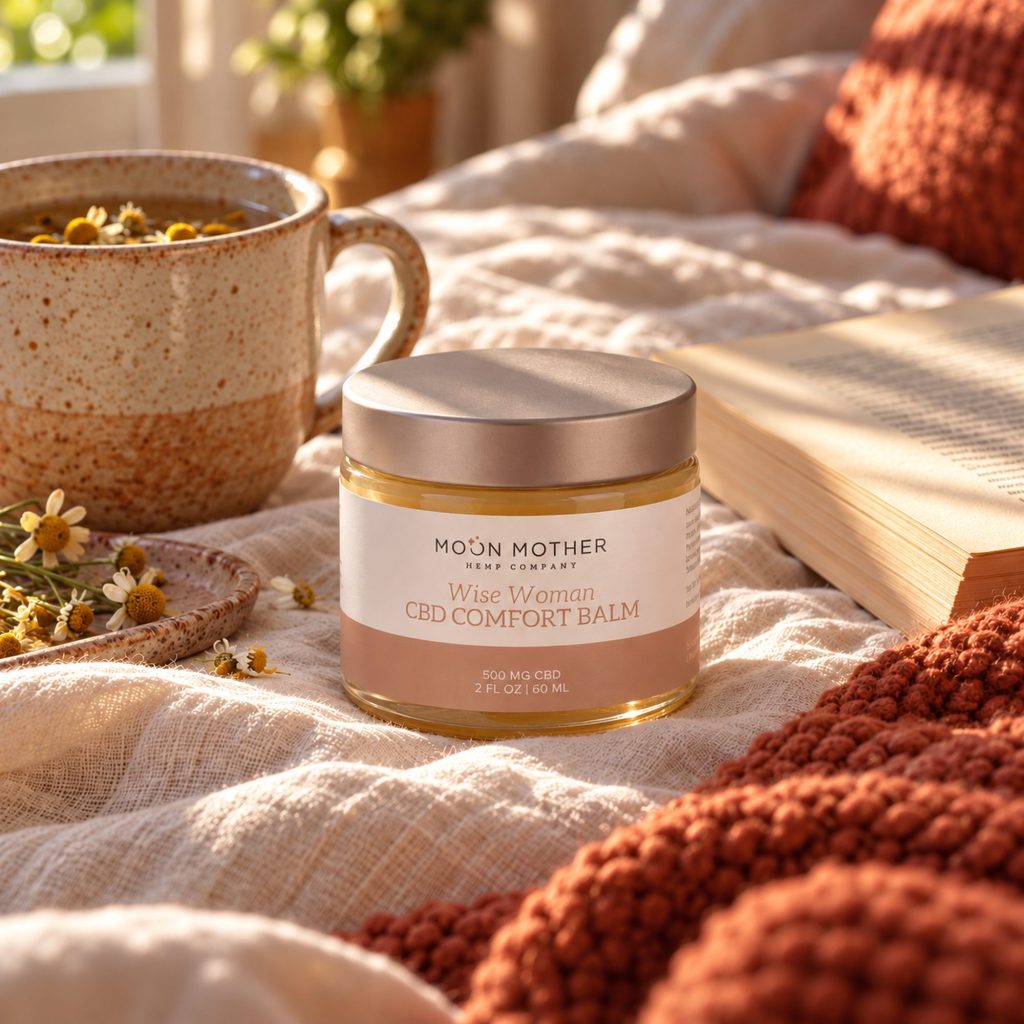
We don’t claim our balm treats cramps or any other condition. Our certified clinical herbalist created Wise Woman Comfort Balm as a soothing companion for a self-care massage: chamomile, rose, arnica, St. John’s wort and hops slowly infused in organic jojoba oil for more than 30 days, with a gentle rose and cardamom scent and 500 mg of CBD from full spectrum hemp extract made from certified organic hemp. Pair it with a heating pad and our Wise Woman Ritual Bath, or get both in the Moon Time Bundle.
This article is for general information and isn’t medical advice. These statements have not been evaluated by the Food and Drug Administration. Our products are not intended to diagnose, treat, cure or prevent any disease.
These statements have not been evaluated by the Food and Drug Administration. These products are not intended to diagnose, treat, cure or prevent any disease.